
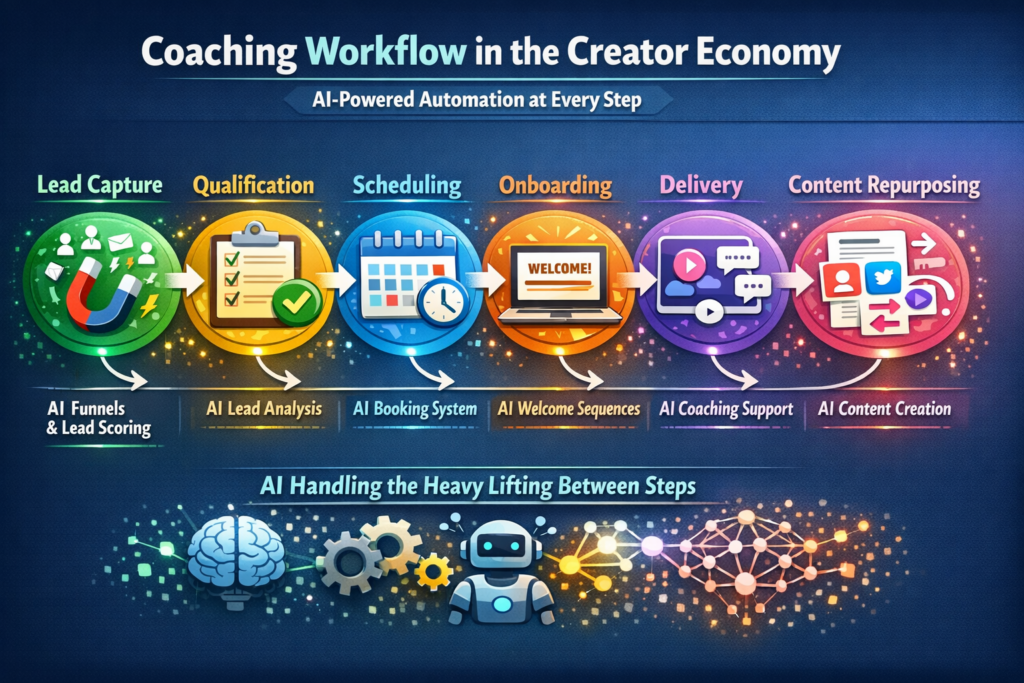
Most people ask, “Why upgrade my workflow?”
Wrong question.
The real question is: Why are you still babysitting tasks a robot could handle?
Here’s the contrarian take.
Stop pretending busywork is “the grind.”
Creators and coaches love to say they’re grinding. But saving files, tagging posts, copying links, sending the same email 27 times—that’s not grind. That’s administrative gravity.
Gravity feels productive because you’re moving. But you’re moving sideways.
Many creators spend 40–50% of their week on tiny, repetitive tasks. Tiny means small actions that require little thought but constant repetition. They don’t build leverage. Leverage means doing something once and benefiting many times.
Modern workflows automate those micro tasks. Automation means a tool performs a rule-based action without you manually doing it. When that happens, your week stops leaking hours. You get those hours back for thinking, creating, selling, and serving.
And thinking is where the money hides.
Your creativity is not fragile. Your workflow is.
People say they’re “burned out creatively.” Often they’re just buried in admin.
Context switching—jumping from one type of task to another—costs mental energy. Science shows that your mind pays a reset cost every time it switches tasks. That reset drains focus.
If the first two hours of your day are spent posting, tagging, scheduling, replying, formatting, and checking five dashboards, your best thinking time gets spent on clerical work.
A modern workflow pushes admin to the background. Templates reduce decisions. Automation handles repetition. AI assists with first drafts and sorting.
You stay in the creative zone longer. Zone means sustained focus on one meaningful task. That’s where quality improves. Not from more hustle, but from fewer interruptions.
Consistency is not about discipline. It’s about systems.

Most creators blame themselves when they miss posts or follow-ups. They say, “I need more discipline.”
No. You need fewer manual steps.
Manual workflows break under pressure. A busy week hits, a client issue pops up, and suddenly three posts vanish and two follow-ups never get sent.
An upgraded system—meaning connected tools with automation and reusable templates—keeps things running even when you’re not in peak mode.
Publishing happens. Emails send. Leads get nurtured. Engagement gets tracked.
Discipline is noble. Systems are reliable.

Scaling without systems is just volunteering for exhaustion.
You can handle five clients manually. Maybe ten. After that, the cracks show.
Scaling means increasing output—clients, content, revenue—without increasing hours at the same rate.
When your workflow connects lead capture → nurture → offer → delivery, you reduce friction at every step. Friction means resistance in a process that slows things down or creates errors.
Creators who connect and automate key stages often see 30% or more increases in reach and double-digit revenue lifts. Not because they suddenly became geniuses. Because their effort compounds instead of resets each day.
Without systems, growth multiplies stress. With systems, growth multiplies impact.
Guessing is not strategy.
Older workflows scatter data across tools. Some metrics live in email software. Others in social platforms. Some never get tracked at all.
That means decisions get made on vibes.
An upgraded, AI-aware workflow centralizes analytics. Centralize means bringing information into one unified view. You can see what content performs, which offers convert, which channels generate real leads.
Instead of asking, “What should I post?” you ask, “What worked?” Then you double down.
Data doesn’t replace creativity. It sharpens it.
Here’s the uncomfortable truth: staying with a clunky workflow feels safe because it’s familiar. But familiarity is not strategy. It’s inertia.
You don’t need to upgrade because everyone else is.
You upgrade because your time is too expensive to waste on copy-paste work, your focus is too valuable to burn on admin, and your growth should come from systems—not stamina.
In business, the future doesn’t belong to the busiest creator.
It belongs to the one who builds machines that work while they think.